Someone finds you in search or in an AI answer, spends five minutes reading about your business, and reaches out on their own. They show up in sales asking about price, not "what do you do." We make hundreds of these pieces a month and publish them on your own domain, not a rented platform.
Do the math yourself: 1,031 pages is 761 blog articles plus about 270 reference and support pages, all in four months across four sites. That's more than five articles a day. A full-time writer manages 4–8 a month.
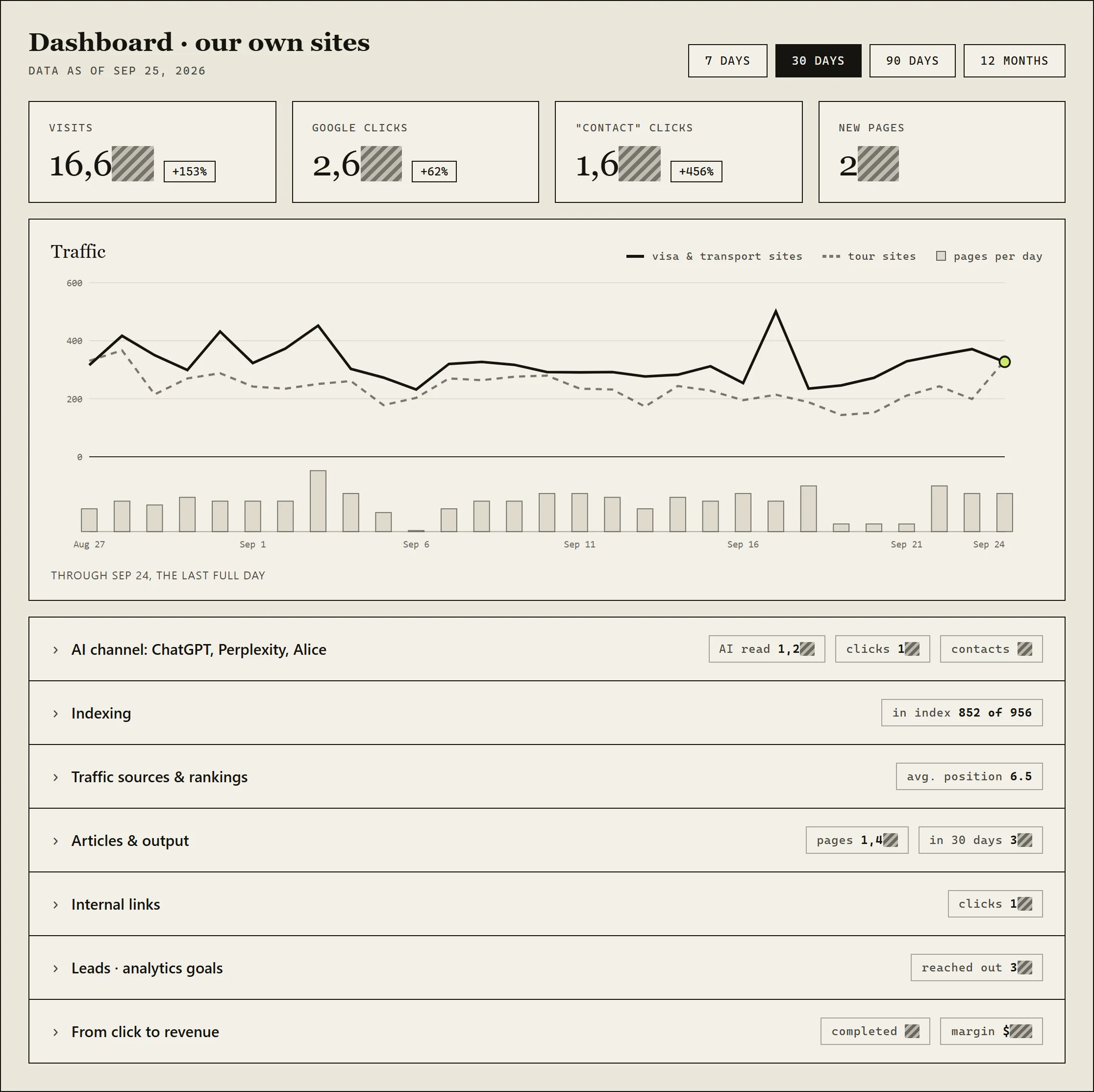
Our four domains started at zero: no content, no backlinks, no age, no ads. New sites usually get almost nothing from search: 86% of Google's top-10 pages are over a year old, and the average #1 page is 5 years old (Ahrefs, 2025). We got here in four months from scratch. That means 15,635 visits in 28 days and 1,204 AI reads in 30 days through Sep 22.
The first article went live on May 2, 2026. The chart shows how many came out each month, and how many piled up.
July was a one-off manual push; since August we run on a fixed automated schedule, and September's daily pace is already above August's.
How many pages did your team ship in the same four months?
One production line wrote and published every page on these four sites, and the same system counted every click. We don't sell a tool we don't use ourselves.
Yandex Metrika, page views over 30 days through Sep 23, 2026, across all four sites. On the .ru sites the counter only fires after a visitor accepts the cookie banner. The real numbers are higher than these.
Send us your niche and I'll pull together three pieces built around your own search terms in a day, and tell you honestly if there's something worth taking. No contract, no payment.
Send your niche →We didn't write about visas. We mapped demand: what questions people ask before they buy, and which of those questions they pay to have answered. We turned those questions into pages. Your questions are different. The order is the same.
First we read what you've already published. From you we need access and one conversation with someone who knows the product. From there, the line writes in your voice.
Sample pieces built around your real search terms, in a day: topic, structure, text, formatting: the same shape a piece takes when it goes live on your site. Not a deck, not an example from someone else's niche.
Like it, we move to a trial. Don't like it, keep the samples. You owe us nothing.
The AI-search era has already started. An assistant names two or three companies, not a list of ten links. The choice gets made before the buyer opens a single site. Below is only AI-assistant traffic on our own sites over 30 days, not our whole traffic.
Source: our own dashboard, snapshot Sep 22, 2026, 30-day window.
Ask ChatGPT who to go to in your niche. If it names a competitor, send us your niche. We'll find out how they got there.
Check your own results →Ordinary SEO ends with "traffic went up." Every contact button we use is tagged: we know which page someone clicked from, and once they write to us, we know it was that page that brought them. We tracked this for 11 days:
Niche measured: Vietnam visas and transport. Your numbers will be your own. Source: our own dashboard, snapshot Sep 20, 2026, 11-day window. We set up the same dashboard for you. It's part of the second package.
Ten spots in the results already belong to someone, and the assistant builds its answer from those same ten. The only way in is to publish more pages than the niche can fill.
Yes, a machine drafts it. You're paying for what a chatbot subscription doesn't give you:
One of the seven checks is 31 editorial rules. They catch clichés and typical AI phrasing, dashes used instead of a verb, sentences that run too long, empty transitions, "as mentioned above," the answer spoiled in the first paragraph, the pitch before the pain point.
Counted from our own pipeline's code, Sep 23, 2026.
The draft goes through these checks before a person ever sees it. Some are hard stops: no headline, no description, no images, or a link to a messenger blocked in Russia, and the page simply won't build.
The person in the loop owns what the machine can't: tone, which topics matter most, disputed claims.
That machine-written text beats a strong writer: in Semrush's study of 42,000 articles in the top spot, human writing wins. We win on something else: a full-time writer manages up to eight articles a month; our line does hundreds in the same time.
| How this usually gets done | What it costs | Our line |
|---|---|---|
| Freelance marketplace writerprice per article, no research and no publishing | $20 – 160 per 1,000-word articleTextbroker, Crowd Content, WriterAccess: quality swings from writer to writer | $42 per piecein a package of 60+ a month: research, images, formatting and publishing all included |
| Self-serve AI writing toolByword, Koala, Drafthorse and similar | $0.50 – 30 per articleraw text only: no topic research, no publishing, no lead tracking | $42 per piece, and that's the whole jobresearch, publishing, and lead tracking are already in the price |
| Full-time writer, USsalary, taxes, benefits, vacation | ≈$7,700 – 8,300/mo fully loadedand about 20–26 articles a month, on our own estimate | $2,500 a month is 60 piecesthe same month, without hiring a replacement in January |
| How much of that reaches the topthe top gets what survives, not what's published | 0.3 pages a monthat eight articles, a full-time writer's ceiling | 2.8 pages a monthat eighty, between our first and second package |
| Doing nothingthe searches go to whoever is publishing | $0 todayand a growing ad bill later: $5.42 average cost per click in the US | articles from early summer bring people in todayeach new one stacks on the last and stays yours |
A premium content-marketing retainer runs $8,000–30,000 a month (Siege Media, Animalz, third-party estimate) for a fraction of this volume. Eighty pieces a month by hand is a payroll line that never pays for itself. We just don't know how to make it that expensive.
Google doesn't penalize text for being machine-written. It penalizes pages made in bulk to game rankings that don't help the reader. Its spam policy calls this scaled content abuse. So we cap the pace: a young site starts at the bottom of the range and grows into it, and every piece goes through 20 steps with a person signing off on topics and claims. That's why packages top out at 200 pieces.
Turn the ads off and the leads stop the same day. You pay for an article once, and people keep arriving from it every month.
The pages live on your domain: if we ever part ways, they keep working for you. Auction prices climb every year. The price of an article you already published never changes.
↑ that gap is what you're paying for
Three packages. The price per piece barely changes between them. What changes is what we do on top of the writing. Package prices are public; we don't do "price on request."
Instead of a full invoice, we take a small base fee plus a share of the leads and of the revenue organic search brings in. The terms are ours, not yours: a non-refundable setup fee, metrics written into the contract, access to your CRM. We don't run the numbers without that.
We take on no more than two clients like this at a time, and only ones with someone on staff to close the leads we bring in.
From package 2 up, the dashboard is already included. On package 1 we set it up separately: configured for your site, then maintained. Connecting it to your CRM is package 3 only. Setup price depends on how complex your site is. We quote it on the first call, before any contract.
Not a demo and not a PDF audit: we take your real search terms and work at full speed. The articles stay yours even if we part ways.
We sign a contract and work for two weeks. If you like it, you pay for one week at your package rate; the second week is on us. If you don't, you pay nothing. There won't be a flood of customers in two weeks. Results in search build up over months, and promising otherwise would be a lie. What you will see: publishing pace, indexing, the first visits. We run no more than two trials a month.
I look at the demand, set up the line, own the deadlines, and decide whether we take your niche. No ticket system, no account manager in between.